


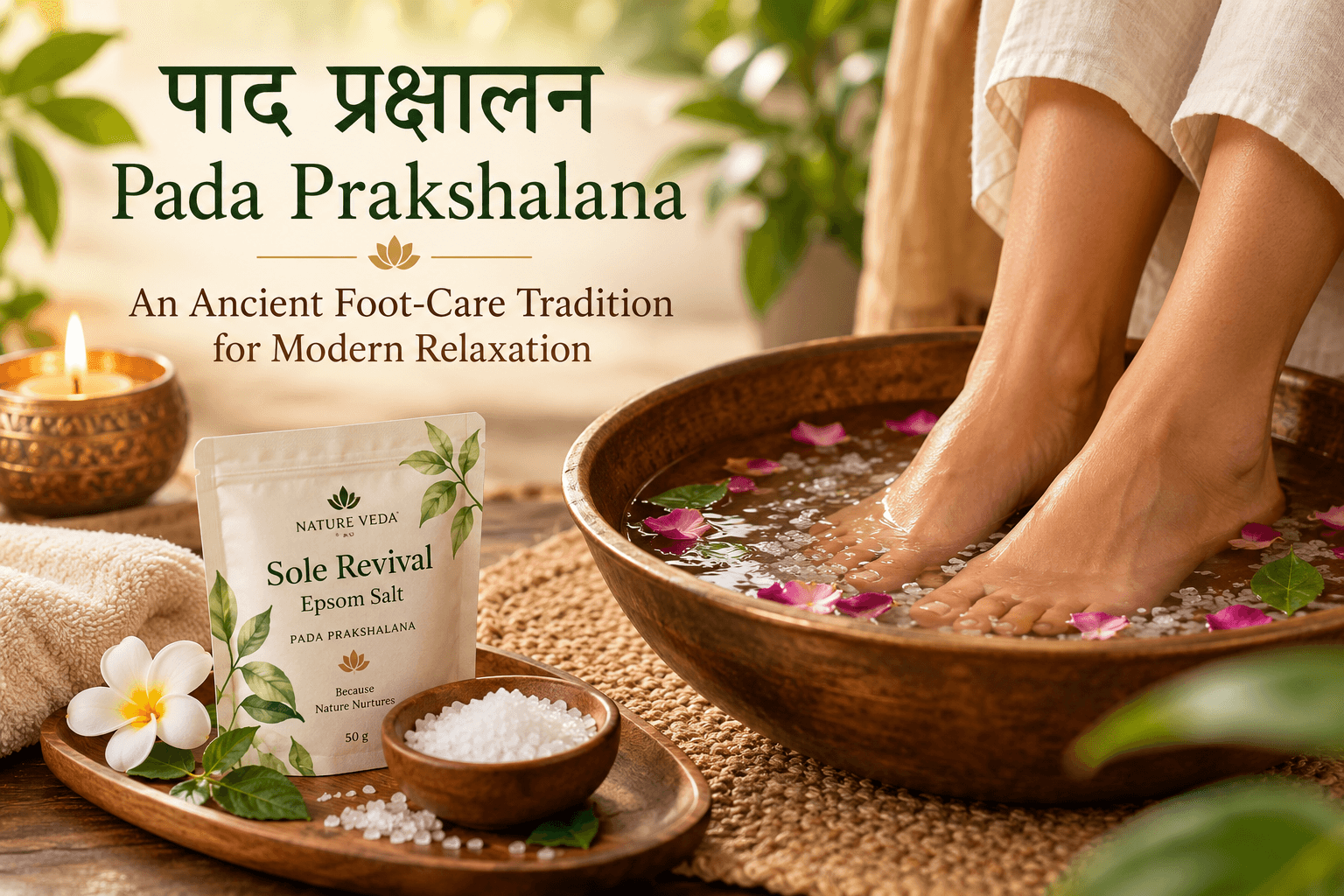
पाद प्रक्षालन | Pada Prakshalana
An Ancient Foot-Care Tradition for Modern Relaxation
Discover the traditional wisdom of foot cleansing, the comforting benefits of warm foot soaking, and Nature Veda’s Sole Revival ritual.
In Ayurveda, even the simplest daily rituals hold meaning. One such practice is Pada Prakshalana (पाद प्रक्षालन) — the traditional practice of washing and cleansing the feet.
Rooted in Indian self-care traditions, this practice reminds us that wellness is not always about elaborate routines. Sometimes, it begins with something as simple as caring for our feet.
Let’s explore its traditional significance, the comforting benefits of warm foot soaking, and how Nature Veda’s Sole Revival brings this inspiration into modern self-care.
What Is Pada Prakshalana (पाद प्रक्षालन)?
In Sanskrit, Pada (पाद) means foot, while Prakshalana (प्रक्षालन) means washing or cleansing.
Together, Pada Prakshalana describes the practice of washing and cleansing the feet.
In traditional Indian daily-care practices, washing the feet has long been associated with cleanliness, refreshment and personal care.
This simple ritual offers an opportunity to slow down, refresh the feet and create a moment of calm in everyday life.
What Does the Charaka Samhita Say About Foot Care?
The Charaka Samhita, one of Ayurveda’s foundational classical texts, discusses the importance of daily personal-care practices.
In Sutra Sthana, Chapter 5, the text describes Abhyanga, or oil massage, as part of traditional daily care.
The chapter also discusses care of the feet, reflecting the attention given to everyday hygiene and wellbeing in classical Ayurvedic traditions.
Another traditional practice, Padabhyanga (पादाभ्यङ्ग), refers to massaging the feet with oil.
Although foot washing and foot massage are different practices, both illustrate the importance of caring for the feet in traditional Indian wellness.
An important distinction: Epsom salt is a modern bathing ingredient, not a classical Ayurvedic ingredient. Nature Veda’s Sole Revival is inspired by traditional foot-care philosophy rather than presented as an ancient Ayurvedic prescription.
Introducing Sole Revival – A Modern Pada Prakshalana Ritual
Inspired by the simplicity of traditional foot care, Nature Veda Sole Revival combines comfortably warm water with Epsom salt to create a soothing personal-care experience.
Our 50 g Epsom salt pouch is designed for a convenient, single-session foot soak.
It’s a simple invitation to unwind after a busy day, refresh your feet and enjoy a few peaceful moments for yourself.
Ancient inspiration. Modern simplicity. Because Nature Nurtures.
What Is Epsom Salt?
Despite its name, Epsom salt is not ordinary table salt.
Epsom salt is magnesium sulphate, a mineral compound commonly used in bathing and foot-soaking products.
Unlike table salt or Sendha Namak (rock salt), which are primarily sodium chloride, Epsom salt contains magnesium and sulphate.
When dissolved in warm water, it creates a mineral-salt bath that can be enjoyed as part of a relaxing foot-care ritual.
But what are the benefits of this simple practice?
Five Benefits of a Warm Epsom Salt Foot-Soaking Ritual
1. Comfort for Tired Feet
Our feet work hard throughout the day, especially when we spend long hours standing, walking or wearing enclosed shoes.
A short soak in comfortably warm water can feel soothing and refreshing after a demanding day.
Whether you’re a healthcare worker, retail worker, busy parent or someone who spends a lot of time on your feet, this ritual can be a welcome way to unwind.
2. Encourages Relaxation
A foot soak offers more than physical comfort.
It creates an opportunity to pause, disconnect from daily demands and enjoy a few quiet minutes.
The warmth of the water and the restful setting can make the experience feel calming.
Sometimes, the simplest self-care rituals are the easiest to maintain.
3. May Support a Calming Bedtime Routine
Warm foot soaking has attracted scientific interest for its possible relationship with relaxation and sleep.
Some studies suggest that warm foot baths before bedtime may improve perceived sleep quality in certain groups of people.
One possible explanation involves body-temperature regulation. Warming the feet may encourage heat release through the skin, which is associated with the body’s natural preparation for sleep.
However, research findings are not consistent across all populations.
A warm foot soak is best viewed as a comforting evening habit, not a treatment for insomnia.
4. Temporarily Softens the Skin
A brief warm-water soak can soften the outer layers of the skin, making gentle cleansing and routine foot care more comfortable.
After soaking, dry your feet thoroughly and apply a suitable moisturiser if desired.
Avoid prolonged soaking or excessively hot water, which can irritate or over-soften the skin.
5. Creates a Mindful Self-Care Moment
Modern life often leaves little time for personal care.
A warm foot soak can become a small daily or occasional ritual that encourages you to slow down.
You don’t need expensive equipment or a complicated routine.
Just a clean basin, comfortably warm water, Epsom salt and a little time for yourself.
Magnesium, Melatonin and Sleep: What Does Science Say?
You may have heard that magnesium can help improve sleep or increase melatonin, the hormone involved in regulating the sleep–wake cycle.
Magnesium is an essential mineral that contributes to normal nervous-system and muscle function.
Researchers have investigated relationships between magnesium status, sleep and sleep-related processes.
However, there is insufficient reliable evidence that magnesium from Epsom salt foot baths is absorbed through intact skin in meaningful amounts.
There is also no established evidence that soaking your feet in Epsom salt water increases melatonin production.
The more credible explanation for the comfort of foot soaking relates to warm water, relaxation and changes in body-temperature regulation.
At Nature Veda, we believe traditional wellness inspiration and modern science can be shared together, without exaggerated promises.
How to Enjoy the Nature Veda Sole Revival Ritual
Step 1: Prepare Your Space
Choose a peaceful, comfortable place where you can sit and relax.
Fill a clean basin with approximately 3–5 litres of comfortably warm water, enough to immerse both feet.
Step 2: Add Sole Revival
Empty one 50 g pouch of Nature Veda Sole Revival Epsom Salt into the basin.
Stir gently until dissolved.
Step 3: Soak and Unwind
Place both feet in the water and enjoy approximately 10–15 minutes of relaxation.
You may listen to soft music, practise slow breathing or simply enjoy a few quiet moments.
Step 4: Dry and Moisturise
Remove your feet and dry them thoroughly, particularly between the toes.
Apply a suitable moisturiser if desired.
Step 5: Enjoy Your Evening
Continue your evening at a comfortable pace.
Let your foot-soaking ritual be a gentle reminder that caring for yourself doesn’t need to be complicated.
When Is the Best Time for a Foot Soak?
Many people enjoy foot soaking in the evening, especially after a day involving prolonged standing or walking.
Others prefer it whenever they have time to sit comfortably and unwind.
There is no single perfect time.
The best time is when you can enjoy the ritual safely and without rushing.
Important Precautions
Although warm foot soaking is a common personal-care practice, it may not be suitable for everyone.
Avoid soaking if you have open wounds, broken or infected skin, or significant irritation.
If you have diabetes, reduced sensation in your feet, poor circulation or a condition affecting wound healing, seek professional healthcare advice before soaking.
Use comfortably warm, not hot, water. Stop if irritation or discomfort develops.
Epsom salt is for external use only and must not be swallowed.
A Little Care for the Feet That Carry You
When was the last time you thanked your feet?
Our feet carry us through busy mornings, long working hours, family responsibilities and countless steps.
Yet, when evening arrives, they’re often forgotten in our self-care routines.
Sometimes, self-care doesn’t begin with your face or your hair. It begins at your feet.
A few peaceful minutes can be a beautiful way to acknowledge everything your feet do for you.
Discover Sole Revival by Nature Veda
At Nature Veda, we believe that traditional inspiration can bring meaning to modern everyday routines.
Our Sole Revival – Pada Prakshalana is an Ayurvedic-inspired Epsom salt foot-soaking ritual, thoughtfully portioned into a convenient 50 g pouch.
It’s not about complicated wellness promises.
It’s about creating a simple moment to pause, refresh and reconnect with yourself.
Explore Our Ayurvedic-Inspired Wellness Collection
Discover Sole Revival – Pada Prakshalana, our modern foot-soaking ritual, alongside Navel Nourish – Nabhi Abhyanga, our traditionally inspired navel-oiling ritual.
Two simple ways to bring intentional self-care into everyday life.
Nature Veda — Because Nature Nurtures.
Ancient Wisdom for Modern Wellness.
Explore our collection: https://natureveda.com.au
WhatsApp: 0420 898 081
Handmade and thoughtfully curated skincare, haircare and wellness rituals from Adelaide, South Australia.
References and Further Reading
- Charaka Samhita, Sutra Sthana, Chapter 5 — traditional discussion of daily personal-care practices, including Abhyanga. The classical discussion does not prescribe Epsom salt soaking.
- Haghayegh, S., Manzuri, L., & Lastella, M. (2019). Before-bedtime passive body heating by warm shower or bath to improve sleep: A systematic review and meta-analysis. Sleep Medicine Reviews, 46, 124–135. https://doi.org/10.1016/j.smrv.2019.04.008
- Gröber, U., Werner, T., Vormann, J., & Kisters, K. (2017). Myth or reality—Transdermal magnesium? Nutrients, 9(8), 813. https://doi.org/10.3390/nu9080813
Disclaimer: This article is for general education and personal-care information. Sole Revival is not intended to diagnose, treat, cure or prevent any medical condition. Traditional wellness practices are discussed as cultural inspiration, not as proof of medical effectiveness.