


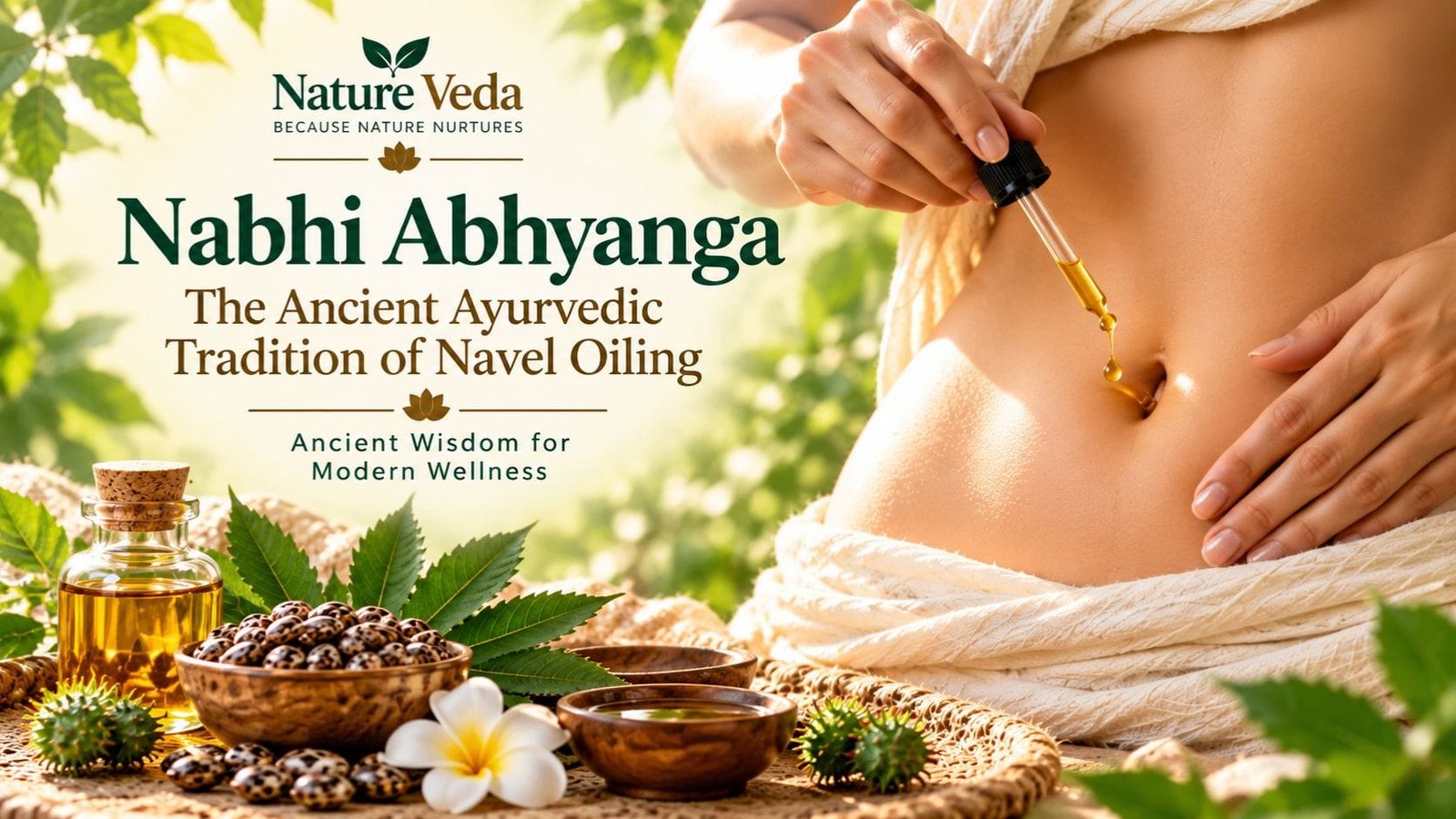
Nabhi Abhyanga: The Ancient Ayurvedic Tradition of Navel Oiling
Have you ever wondered why the navel holds a special place in traditional Ayurvedic wisdom?
In a world filled with complicated self-care routines, sometimes the simplest rituals invite us to slow down and reconnect with ourselves.
One such practice is Nabhi Abhyanga (Navel Oiling), a traditional-inspired ritual involving the gentle application of oil to the navel area.
At Nature Veda, we believe that understanding the tradition behind a ritual is just as important as practising it.
What Is Nabhi Abhyanga?
The term comes from two Sanskrit words:
- Nabhi (नाभि) — Navel
- Abhyanga (अभ्यङ्ग) — Oil massage
Together, Nabhi Abhyanga describes the practice of gently applying and massaging oil around the navel.
The navel is an important anatomical landmark in Ayurvedic literature. In traditional Ayurvedic thought, it is associated with the body’s central region and is discussed in the context of Marma, or vital points.
Navel oiling is also discussed in contemporary traditional-wellness communities under names such as Nabhi Poorana.
The History of Ayurveda: More Than 2,000 Years of Tradition
Ayurveda originated in ancient South Asia and developed over many centuries.
Its surviving classical literature includes the Charaka Samhita, Sushruta Samhita and later texts such as the Bhavaprakasha.
These works describe traditional approaches to daily routines, massage, oils and the human body.
However, it is important to distinguish the long history of Ayurveda from the age of any particular ritual. We cannot reliably establish that today’s practice of placing castor oil in the navel has been performed in exactly the same way for thousands of years.
What Does the Charaka Samhita Say?
The Charaka Samhita is one of the foundational texts of classical Ayurveda.
Its first major section, Sutrasthana, discusses principles of health, daily routines and traditional care practices.
In Sutrasthana, Chapter 5, verses 85–89, the text discusses Abhyanga, the application of oil and massage to the body.
These verses traditionally associate oil massage with the care of the skin and body and with the Ayurvedic concept of Vata.
An important historical distinction: This passage discusses oil massage generally. It does not specifically instruct readers to place castor oil inside the navel or cover it with a cotton pad.
For Nature Veda, this reference provides historical context for oil-based self-care rather than proof of the exact modern navel-oiling method.
What About Nabhi Poorana?
Nabhi Poorana is another term encountered in discussions of traditional navel-oiling practices.
Some later Ayurvedic literature and contemporary scholarly discussions describe methods involving the retention of substances around the navel.
The Bhavaprakasha, a later Ayurvedic text, has been cited in discussions of such practices.
However, the precise original passage, translation and relationship to modern castor-oil navel application require careful textual verification.
For this reason, Nature Veda does not claim that the exact contents or method of our Navel Nourish Ritual Kit were prescribed by Charaka or any other classical author.
Why Castor Oil?
Castor oil comes from the seeds of the Ricinus communis plant.
Known traditionally as Eranda Taila, castor oil has a long history of use in various traditional oil-based practices.
Nature Veda’s Navel Nourish Ritual uses pure, cold-pressed castor oil, presented as a simple external self-care experience.
We value castor oil for its rich texture and its place in traditional oil-use practices, without suggesting that applying it to the navel treats medical conditions or produces specific internal health effects.
How to Practise the Nature Veda Navel Nourish Ritual
Creating a moment for yourself does not need to be complicated.
Step 1 — Prepare
Clean and gently dry the navel area. Wash your hands before applying the oil.
Step 2 — Apply
Place 2–3 drops of castor oil onto clean fingertips.
Step 3 — Massage
Gently spread the oil around the navel area using light circular movements. Avoid vigorous rubbing or filling the navel with oil.
Step 4 — Enjoy Your Moment
Take a quiet moment to relax. Wipe away any excess oil afterwards.
This is a modern, gentle interpretation of traditional oil application rather than a reconstruction of a specific ancient prescription.
Important Care Information
Navel Nourish is intended for external cosmetic and personal-care use only.
Before first use, patch-test a small amount on intact skin and discontinue use if redness, itching or irritation develops.
Do not apply to broken, infected or irritated skin, or to an unhealed navel piercing. Avoid contact with eyes. Keep out of reach of children.
Do not use oil-soaked cotton pads under a tight or prolonged covering unless the materials and method have been confirmed suitable for that purpose.
This ritual is not intended to diagnose, treat or prevent medical conditions.
Nature Veda: Ancient Wisdom for Modern Wellness
At Nature Veda, our inspiration comes from traditional Ayurvedic knowledge, botanicals and simple moments of self-care.
Our Navel Nourish – Nabhi Abhyanga Ritual Kit brings that inspiration into a contemporary experience, thoughtfully prepared in Adelaide.
We believe traditional practices deserve to be shared with curiosity, respect and an honest understanding of their history.
Because sometimes self-care is not about doing more.
It is about making a little time for yourself.
Nature Veda
Because Nature Nurtures
Explore our Ayurvedic-inspired hair and skin-care collection at www.natureveda.com.au.
Historical References and Further Reading
- Charaka Samhita, Sutrasthana, Chapter 5, verses 85–89 — Classical discussion of Abhyanga (oil massage).
- Sushruta Samhita, Sharirasthana, Chapter 6 — Classical discussion of Marma (vital anatomical points).
- Bhavaprakasha — Later Ayurvedic literature referenced in modern discussions of navel-related traditional practices. The exact passage concerning oil retention requires independent verification.
Historical descriptions of Ayurvedic beliefs are provided for cultural and educational understanding. They are not evidence of medical benefits from navel oiling.